
Just like the simulations
The Year 2036

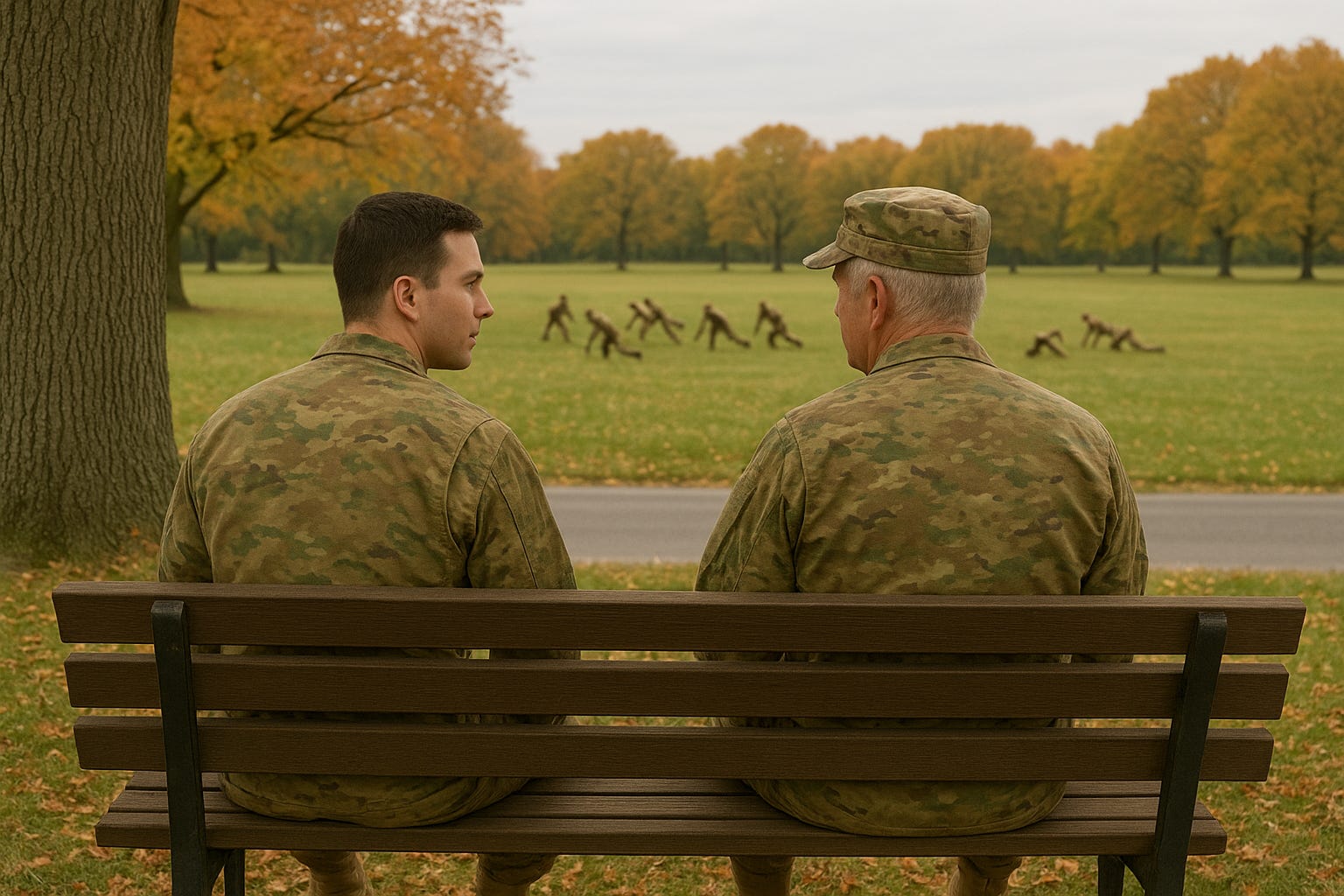
There he was, sitting on the bench as agreed, my mentor, colonel Aralani. This was going to be our second meeting. In the first one, it was all about introductions and him asking all these obvious questions about my background, interests and what he, Sam, needed from his mentor. Well, he never asked for a mentor. They just got one assigned here at the Captains Career School, whether you liked it or not. Sam was almost within reach and before he could even greet him, the colonel beat him to it: “you’re late, come sit down.”
“My apologies sir” Sam said, while sitting next to him. “no worries” he said, while gesturing at the scene some hundred metres in front of him, where dozens of troops were doing PT at the field. “Look at them, working out and sweating. What do you think will win wars? Working out, getting strong. Or having conversations with an old man?”
Damn it, Sam thought. What kind of riddle was this? Of course he had to answer that talking to him was more important, although he’d rather be up there on the field, exercising. “Of course talking to you Sir. Anyone can do PT. Not everyone has the honour of learning from someone like you” Sam said quickly.
The colonel laughed hard at that. “Either you are clearly well ahead of your peers, or, you are just like me at your age, when I would rather be up there, on the field” Sam could not help feeling somewhat embarrassed, perhaps it showed.
“Well, let’s skip all the formalities of asking how well your training is going, whether the food is good and the like. I asked most of the questions the last time. Now it is your turn. Ask me anything. Especially those questions that you silently ask yourself, but don’t dare to ask in the classroom.”
Sam was silent for a moment, and so was the colonel, suspiciously long actually. He was just staring in the distance, as if he had all the time in the world. Yes, there was this question, this doubt. Well, why shouldn’t he ask it?
“Sir, I have my doubts about these training methods of ours” Sam said. “Yes, tell me about them” The colonel said, as if I was stating something arbitrary.
“Well, I have the feeling that we have forgotten how to train for the real fight. There is this old saying: ‘train as you fight’. What those folk are doing over there, on the field, that is real training. I’m stuck in simulators all day. Going through these scenarios, after action reviews, scores, metrics, and then again. We only go out in the field like twice in this entire course. That can’t be in the spirit of ‘train as you fight’, right?”
“An excellent question, and an healthy attitude to doubt whether what you train and how you train is actually valuable. Doubt is a good trait, don’t forget that. Well, how would you arrange the training?” The colonel asked.
“Now I have heard some of the older officers complain about these new methods as well. They said that, back in their day, they went out in the field with the battalion staff and actually maneuvered units all the time. We only do this once, at the end of the course.” Sam explained. “You have probably been there too, right? How was it back when you were a captain?” The Colonel visibly sighed, and he looked Sam straight in the eyes.
“Did these people also tell you how often they did these kind of exercises each year?” Before Sam could answer, the colonel said: “Probably not, because those moments were precious but scarce. Perhaps 4 times a year, of which some were map exercises. That’s hardly more than you do nowadays, believe me. The real question is, what did they do the rest of the time?”
“Um I don’t know, simulations or PT, perhaps?” Sam blurted out.
“Unfortunately not. They were managing projects, doing all kinds of HR stuff, nothing that will make you a better tactician, that’s for sure. Put some officers with enough NCOs and privates in barracks and they will invent work to keep themselves busy and be able to sell it as genuine military practice, merely on the basis that ‘this is what they have done for ages’.”
“But still, some of them claim they did more real practice than we did.” Sam said, not fully convinced yet.
The colonel laughed at that. “Yes, yes, so they say. Do you know why they say this? Because they fear that their so called experience is becoming out-dated. They know that you already have acquired more experience in a much shorter time. It’s not their fault, they were just born in the wrong time. But that’s called progress. Did you know how they trained in the Cold War in Western Europe? They literally only had one plan, which they repeated and trained each year with their conscripts. The plans never changed, only the conscripts did. The officers corps as a result was just rehearsing the same plan over and over. How adaptive do you think these men were? How relevant is this experience in your opinion?” Without giving Sam any opportunity to actually respond, the colonel said with a stern voice: “Never let anyone tell you that we used to be better in the past, nor that experience comes with age, or bullshit like that.”
Sam didn’t know how to answer. After a short pause, the colonel asked: “The real question is, how do you become a better tactician?”
“Well, by doing a lot of exercises, but maybe also doing these tactical decision games, reading history, that sort of things. But mainly doing the real stuff, out there.” He gestured at the training at the field across them.
The colonel smiled at that. “Does it matter how, or how much, or how often?
“Yeah sure it does.” Sam replied.
“How often do you think that is possible? I mean, those guys there on the field can train all day. But how often can you put an officer like you in a situation where he or she has to decide to, for example, deploy the Brigade or Division reserve unit?
“Well.. it would take a lot of troops and effort of course. Perhaps once a month maybe?” Sam said hesitantly.
“Okay, so let’s say we try to achieve that. It will cost your units a week to prepare, at least. Then of course you need to get to the training area, which is ideally not always the same area right next to the barracks. So let’s add another couple of days. Then there are all the logistics that need to be arranged even before that. Let’s add another week. Then there is the scripting and planning of the exercise. The training objectives and scenarios for instance. Do you see that a month is burned up pretty fast? Nor have we even discussed the limited training areas available. All this for putting you and perhaps a handful of officers in the situation where you need to decide whether to deploy the reserve forces or not? Of course, you can see it play out in real time, thereby testing your decision as it were. But success is not always dependent on the decision only. Because of course, Murphy arranged that the vanguard of your reserve forces got delayed because one of their vehicles broke down on a small road, blocking the rest of the forces. These forces weren’t in time and lost momentum. Damn, was it bad luck or a bad decision?”
Sam started to become a bit annoyed and it probably showed: “Sir, if I may. You are now being overly sceptical. Isn’t this just how war works?”
The colonel either didn’t see the irritation or just didn’t bother for he continued his line of questioning. “Exactly. Yet how then, do you create experience and thus expertise? It seems to be important that you know if the success of your decision was merely luck, or tactical insight, doesn’t it?”
“Sir, what you are asking is how we learn, right?” Sam said, a bit wary if he was being tested or not.
“Yes, I think you are right Sam. It is all about learning, the right stuff that is. You will never know for sure what the role of randomness or chaos really was. War is non-linear. It is more or less like the weather. You can never be sure what the ‘correct’ course of action will be. But by a lot of repetition with sufficient variation, you learn to recognize situations and the possible solutions to the problems facing you. Only then can you become more adaptive.”
Sam sighed, a little exasperated, but he understood where the colonel was going with his line of argument. “I understand sir. And this is the reason why the Simulation Centre of Excellence has this code, what was it again.. Oh yes I remember: ‘Predict what will happen, act swiftly, but always seek for indications that you are wrong. If so, adapt.”
“Yes, yes, it is a good code. One that is not only relevant to simulations but decision-making in general, don’t forget that. Yet, there are still quite a number of sceptics around I guess.”
Sam shifted his position towards the colonel and looked at him, somewhat pleading: “Sir, just to be clear. I am not a sceptic about this, I believe this is important. I’m just fed up with all these simulators and perhaps we are taking it too far, but I believe the method for learning is valuable, I really do.”
The colonel patted Sam on his shoulder. “I wasn’t talking about you son, I know you aren’t. And I really appreciate your honesty and most of all, your curiosity and willingness to doubt.” “Tell me, wasn’t there some new program introduced recently?”
Sam veered up a bit. “Yes there is actually. I have already participated in it once, it’s insane. The concept is called the Extremely Rapid Tactical Decision Game, or ERTDG in short. Not so short actually, but what abbreviation is nowadays?” They both laughed at that. And while Sam started talking about this new type of simulation the energy of both men pitched.
“So you are hooked up on a VR system” Sam continued “where you first get a brief scenario where you need to remember the basics of the scenario, but it is actually very dense and there is too little time to actually remember everything. After that, the real fun starts. You get all kind of tactical situations, where you can actually peer outside the vehicle for example, but most of your information is on the digital map and via brief bursts of communication, and then you have to decide. The whole scenario takes maybe less than 2 minutes. After that, you get feedback on the outcome, as in what was the effect. Actually, now I’m thinking about what we earlier discussed, there is no feedback on the decision itself actually” Sam remarked while looking up and clearly contemplating what he just said himself.
Sam, the colonel said: “did I just hear you say ‘fun’?”
“Yes, perhaps.. But what makes it fun is that it feels as if your brains is in overdrive. I have really felt those moments, and here, you get the rush for a complete hour or so. After you disengage from the headset, your head spins and you are completely wasted.” “But what is somewhat disturbing is what you see at that moment around you. Rows of officer with VR goggles sitting in these specialized chairs, sweating, sometimes even cursing and screaming in their headsets, but all within their own worlds. It’s a sort of mix between those old movies, what were their names.. like Gamer and in StarWars: attack of the clones, where all those clones are being ‘programmed’. That image is still somewhat unsettling to be fair.”
The colonel’s eyes squinted a little bit, as in thought. “Well, I ought to go and see that. No better still, I ought to try that.”
‘Yes sir, you definitely should” Sam said.
“Did they explain to you what they aim to achieve?” the colonel asked.
“Yes, the usual stuff. Like that this would make us more experienced and enhance our intuitive decision-making skills.” Sam explained.
“Mmm a shame they put so little effort in explaining things like this” the colonel said, almost as if he was talking to himself. He shifted his position more towards Sam as if to emphasize that what he was going to tell was important.
“Sam, what this new concept tries to achieve, as do all the other simulations, is to gain an edge over our opponents. In speed, accuracy and adaptiveness of our decision-making that is. This is what John Boyd was talking about years ago, he said: ‘in order to win or gain superiority—we should operate at a faster tempo than our adversaries or inside our adversaries time scales. Such activity will make us appear non predictable and thereby generate confusion and disorder among our adversaries’[1]. We do this by training humans, in particular their brains, so that they can use their intuition, based upon experience, to make decisions when there is no time for rational decision-making models. Our greatest weapon is still between our ears.”
“Did you know that this was not always the case?” the colonel said.
“No, what do you mean, not always the case?” Sam said, a bit unsure of himself.
The colonel shifted again on the bench, looking towards the field again, as if readying himself for some lecture. “Some years ago, it was in 2028 I guess, there was an enormous surge in artificial intelligence systems and the defence industry sold it as if it was the magic solution to all our problems.” “Don’t get me wrong, AI has done a lot for us ever since, but there emerged two different groups. Those that wanted to outsource a large chunk of our command and control to AI and those that favored optimizing our brains and using AI only as a tool to support decision-making. They were sometimes also referred to as either the technophiles or the naturalists.”
“Naturalists?” Sam asked quizzically. “Yes, from the term naturalistic decision-making. It is a theoretical branch that stands opposite of the rational decision-making models. It’s not that relevant right now.” The colonel said.
“What is relevant is that many governments were leaning towards the technophile methods. It is, after all, very easy to implement technology, more so than changing how people think. Especially countries like China favored these methods, but for the wrong reasons. AI and algorithms give you the opportunity for centralized command, but more importantly also the ability to control your army. The last thing China wants is soldiers and officers that are trained to think for themselves, lest they might get it into their heads to attempt a coup. Anyways, here we were in 2028, at the crossroads of making important decisions on how to implement and subsequently train our leaders in the armed forces.” The colonel continued.
“Then something spectacular happened in China, which changed how the West viewed this schism ever since. You see, the Chinese have invested everything in AI and their troops already didn’t have much freedom of action before, like what we still call mission command here in the West. What initiative was left has been utterly destroyed by the introduction of their latest command and control system. For it was also being used to monitor possible subversion within the officers corps, none dared to deviate from what the system provided as solutions. Apparently, for not all details have ever been disclosed and part of it is perhaps our own propaganda, several Western intelligence services were able to hack the People’s Liberation Army (PLA) central command and control system, their AI. Instead of slowly manipulating the algorithms and inputs of this system, which they probably did at first, someone thought it was worth the try to see what happened if they really messed up the system in one spectacular blow. During one of the largest exercises China ever put together, these hackers started to mess up the system, and apparently the entire PLA was in complete disarray. There were reports of Chinese units that froze completely and showed no initiative at all. Quite a number of people actually died due to accidents like blue on blue and the like. Do you know what date those sick minds at the intelligence agencies picked? June the 4th.” The colonel had to laugh at this, and he seemed to savor the moment, almost as if he was there when the decision was being made.
“And then?” Asked Sam, thereby pulling the colonel back into the story.
“The West never admitted being involved, but somehow all the Western news agencies were full of very detailed descriptions of what went wrong in China, stressing how vulnerable the PLA actually was. Two months later, the Stavridis doctrine was being implemented within NATO.” The colonel explained.
“Didn’t you work at the agency at the time? Were you involved?” Sam asked.
“I worked there at the time, that’s correct.” The colonel kept starring at Sam, but did not answer the second question. Nor did it seem likely that he would. Sam broke the awkward silence by switching the topic slightly.
“Why was it named the Stavridis doctrine again? I must have learned about this in class but I can’t really remember the details” Sam asked, despite knowing better. Sam wanted to know everything about this event and clearly, the colonel knew more.
“Admiral Stavridis and Elliot Ackerman wrote a book in the ‘20s with the title, 2034: A novel of the next world war. In this book the USA loses a war with China because they have become too reliant on technology. The Chinese are able to hack all the USA’s sophisticated systems like the F-35’s and as a consequence, the USA had to resort to old-school technology, and above all, human ingenuity. That’s the story in a nut-shell. The irony is that the tables are actually turned in reality. China is the one being trapped by technology, AI specifically. But it could have been otherwise.” The colonel explained.
“But we do use a lot of technology, that was my whole point about training in simulations all the time.” Sam exclaimed, almost alarmed.
“The difference” the colonel explained “is that we use technology to train you, not some artificial intelligence. You are our greatest weapon, a human being. What we train is adaptability. For we can never prepare you for the next war entirely. And yes, we also use AI to support our command and control. What was the system called again? Jomini right?” Sam nodded. “What an apt name that is. But still, you also train without this system, right?” the colonel asked.
“Yes sir, we do. Even without communications.” Sam said.
“Right, good to hear. And this, Sam, is all the result of the Stavridis doctrine. They can shoot all the satellites out of space, jam all frequencies and hack every system we have, and you Sam, will do just fine.” The colonel had a smug smile on his face, but also a content one.
“Does this help you in any sense?” the colonel asked Sam.
“Yes it does sir. I would certainly like to know more about how the Chinese rely on their AI and centralized command. Can we talk about that next time perhaps?”
“Yes, sure we can. There is hardly anything more important than understanding your adversary, is there?”
“Thank you sir. I would really love to. I do have to get back to class in a few minutes. Thank you for your time sir.” Sam said and he stood up. So did the colonel and they shook hands. “The pleasure was mine Sam. See you next time.”
Author’s note: This is the first time I write my post as were it a fictional story. Please let me know in the comments if this was a success and whether you would like to see more of these kinds of ‘fictional’ short stories.
Thank you for reading! There are only free-subscriptions to Beyond the Art of War. If you do want to make a contribution, you’re welcome to buy me a coffee!
The views expressed are those of the author and do not reflect the official position of the Armed Forces.
[1] Boyd, “A New Conception for Air to Air Combat,” Boyd and Military Strategy, Defense and the National Interest, 19., in: Ian T. Brown, Frans P.B. Osinga, Snowmobiles [and] Grand Ideals: John Boyd’s Vision for Thriving in Chaos (Quantico, US: Marine Corps University Press, 2025)
This is such a great look at how real learning happens in the profession of arms. The story makes the point clearly: it is not the tool, or the simulator, or the technology that builds better leaders. It is the ability to think, adapt, doubt, question, and make decisions under pressure. The human brain is still the decisive edge. Technology can support it, but it cannot replace it. And the officers who understand that will always outpace the ones who only trust the system.
You would love the book Victoria by William Lind.