

What if you have to make plans or decisions but you have to deal with uncertainty? What if you do not exactly know what you will encounter, where or whom? We often refer to these types of environment as volatile, uncertain, complex and ambiguous (VUCA). These are exactly the type of environments in which military operations take place.
In a VUCA environment, would it be a sound strategy to try to gather as much information as possible first in order to develop a near perfect plan? Before answering this question, let’s look at an example from the world of sports: orienteering. A sport that actually originated in military land navigation exercises.[1]
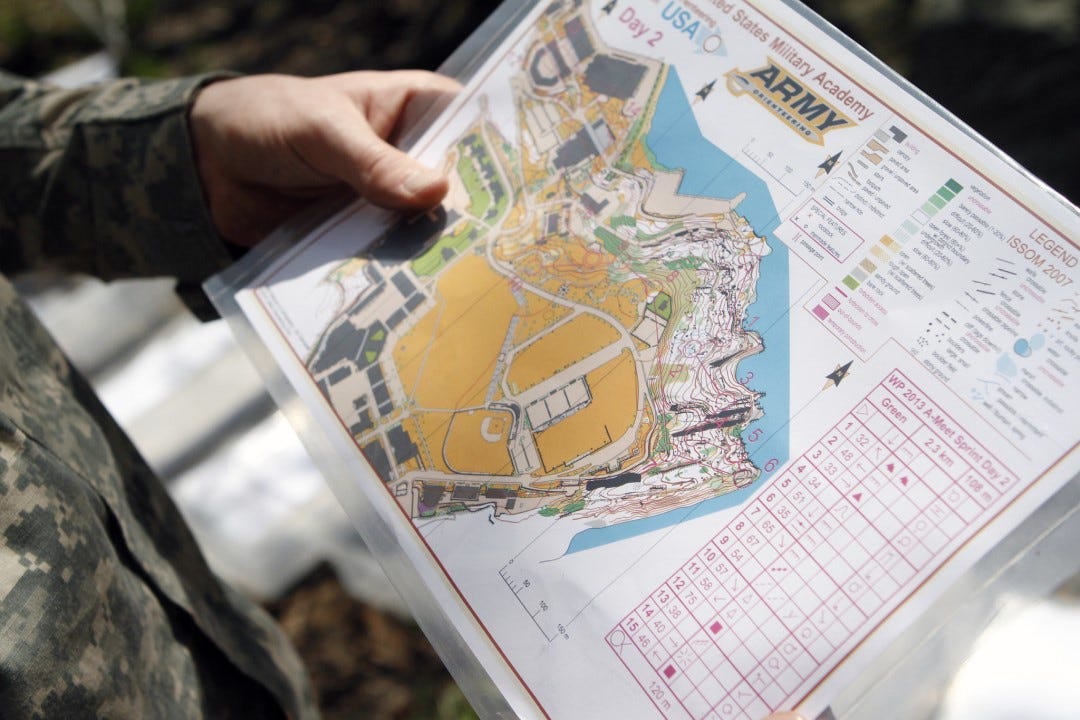
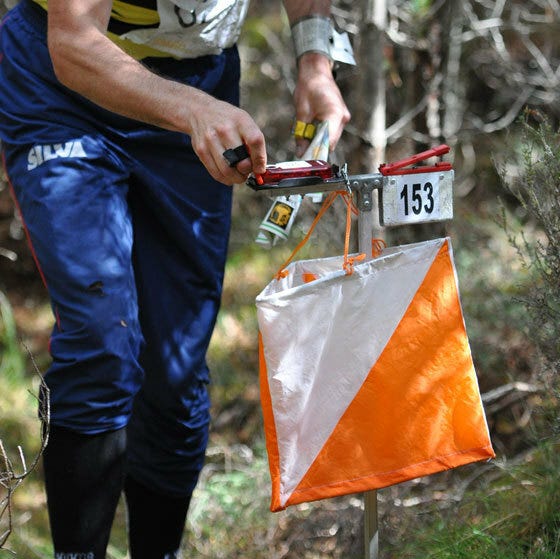
Orienteering is a sport where participants use maps and compasses to navigate from point to point in diverse and usually unfamiliar surroundings, while running. You are in a race to find all the checkpoints. You only get a map with the locations of these different checkpoints and you have to decide yourself which route to take. These locations are never located conveniently (eg. in a gully or in some dense shrubbery) or in a straight line relative to the other checkpoints. It therefore often creates some sort of travellers dilemma (see this earlier post on how nature tries to solves this), meaning it is almost impossible to decide the optimal route. This makes the route anything but straight forward, it is full of twists and turns and difficult to memorize. It also requires you to decide whether to take the road or take a shortcut through the bushes. How much slower will you be able to move through this dense shrubbery? Will I still be able to walk in a straight line towards the checkpoint or will I lose my orientation? You don’t have clear answers to these questions, you only have a map with a legend that ‘sort of’ explains the terrain you will encounter. In other words, there is a lot of uncertainty. How accessible will the terrain actually be? Perhaps more important, how recognisable will this landmark or change in terrain be? Speed is key in winning a game of orienteering, but making sure you don’t lose your orientation along the way is even more crucial. Remember, you do this while running as fast as possible. This will limit your ability to think clearly or to casually look at the map or your compass while moving about. So how do you go about orienteering?
Instead of looking and memorizing the map very thoroughly before racing off, you glance at the map briefly and focus on clear indicators on the route, then you start racing as soon as possible. Instead of relying on your initial memorization of the route entirely without stopping, you try to recognize indicators along the way that confirm or deny that you are heading in the right direction. You often can’t memorize all these indicators, so you just remember the first couple of them and then briefly stop to look at the map, update and reorient. For example: 1) keep the open field on my right hand side, until 2) a forest appears, then 3) take the first route to the right and when 4) the road curves towards the North, stop and reorient.
There is a clear trade-off apparent here. Study the map more thoroughly and remember more indicators along the route, and you will be able to keep running without stopping. Or, only briefly study the map, start running and make regular stops to check and update your route. This is not only about the trade-off between time and the cognitive skill to remember indicators along the route. The crux is that these indicators are often not as obvious in the terrain as they appear to be on the map. This is the real uncertainty you have to deal with, and what necessitates the need to update along the route, no matter how good you have studied the map. This is what adaptability is about. Adaptability can increase your accuracy, but only during the execution of the plan, not beforehand.
Orienteering is a wonderful and useful sport, for it trains you not only to navigate well but also how to make decisions quickly. There are some useful analogies with Naturalistic Decision Making, or specifically the Recognition Primed Decision making model by Gary Klein. The indicators spoken of earlier are like the cues that tell you something is correctly anticipated or that something is off. While studying the map, you mentally simulate the route you are planning to take. For example what will this change of terrain possibly look like, specifically what will constitute as a cue and how you will I recognize it? While running, you will likely simulate this route as well: “I have been running for 200 meters already, I should be encountering a crossing any moment now.” Experience will allow you to recognize different types of crossings more easily, to name one example, but it is about recognizing terrain in general of course. It will also allow you to better simulate the how far you have run on the map and what you should visually encounter to verify your position. You therefore also learn how to measure (or simulate) your own speed, time and the distance traveled.[2]
There is some research on the cognitive processes and decision-making involved when orienteering.[3] [4] What my own experiences showed me is that there is little rational decision-making involved. Much of the choices I made during orienteering were made in split seconds. I did not create multiple courses of action or routes. One route simply appears in your mind and then you start working out the details on how to make it work (eg. what can I recognize along the route to help me steer closer to the checkpoint?). Quite often, my strategy was: “I have no clear idea what this terrain will look like, but I’ll see it when I’ll get there and then figure out my next step.” This may sound irrational or risky, but wasting time staring at a map that will not divulge any more information than I already have is futile and equally irrational.
Some will say that planning is everything (but plans are worthless, as said by Eisenhower). Martin van Creveld has some excellent point on this: “The realization is that certainty is the product of time as well as of information, and the consequent willingness to do with less of the latter in order to save the former.”[5] In other words, we need to accept uncertainty for it is inevitable and thus do with less information in order to win time (see this post for more on time). You win orienteering because you are faster, but it is not about speed. It is about the fact that you need less time to achieve your goals.
As Napoleon is believed to have said:
“Strategy is the art of making use of time and space. I am less concerned about the latter than the former. Space we can recover, lost time never.”
This is part I of a series on decision-making. The next part will focus on how this applies to military staffs like the sections 3 and 5.
Thank you for reading! There are only free-subscriptions to Beyond the Art of War. If you do want to make a contribution, you’re welcome to buy me a coffee!
The views expressed are those of the author and do not reflect the official position of the Armed Forces.
[1] https://en.wikipedia.org/wiki/Orienteering
[2] G. Klein, Sources of Power: How People Make Decisions, (Cambridge: Massachusettes Institute of Technology, 1999)
[3] Waddington, Emma E., and Jennifer J. Heisz. “Orienteering as a Tool for Cognitive Research: An Implementation Guide.” Journal of Visualized Experiments (2024).
[4] Batista, Mayara, et al. “Physiological and Cognitive Demands of Orienteering: A Systematic Review.” Sport Sciences for Health 16 (2020).
[5] Martin van Creveld, Command in War. (Cambridge, MA: Harvard University Press, 1985) (reprint 1987) 270
Great article, thanks!