
Wars are never ‘orchestrated’
So stop using the word.

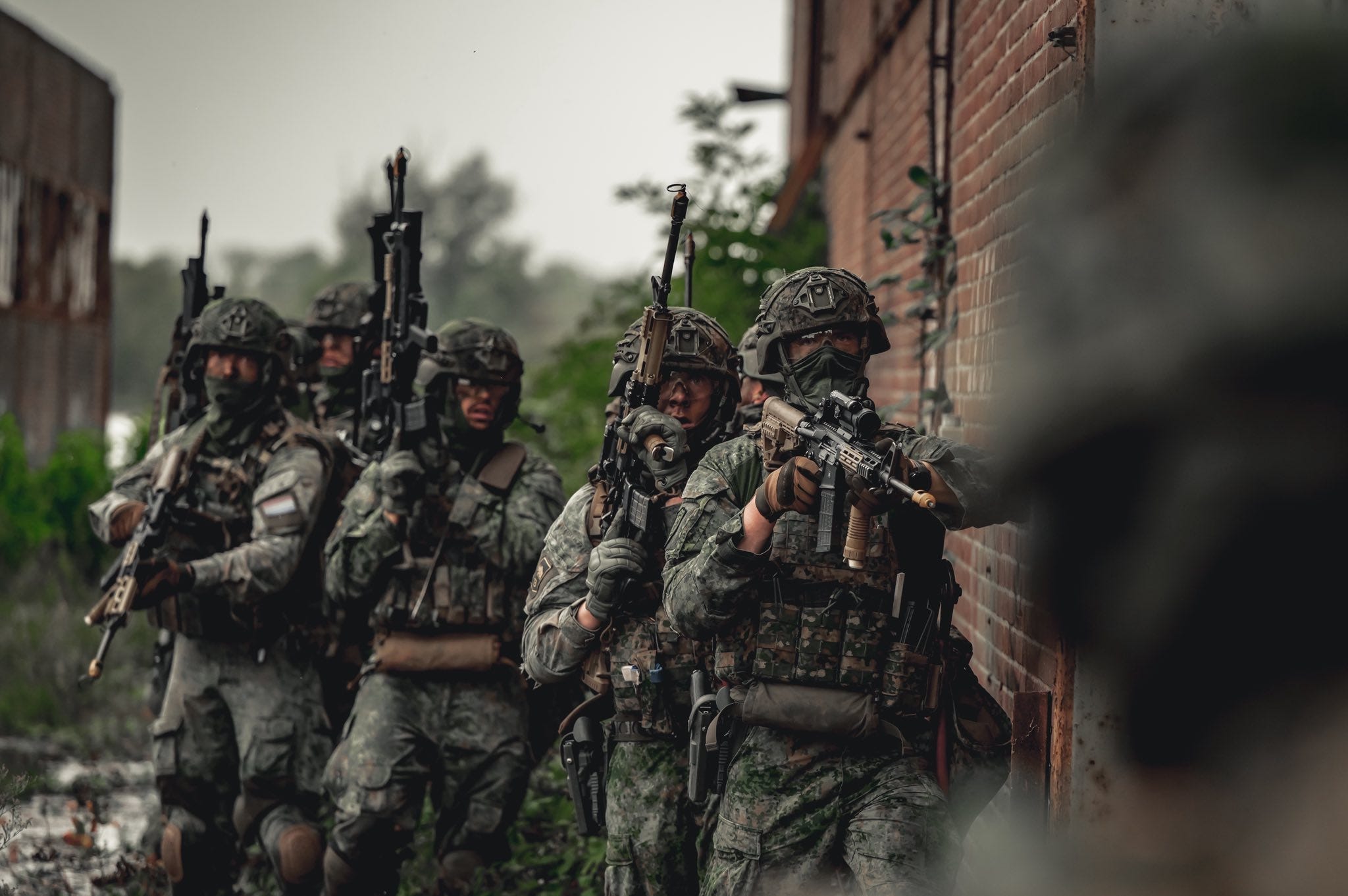
I was recently attending the Dutch Royal Marine concert, a beautiful orchestra of different instruments. Even the Royal Marines and US Marines took part with some excellent drums. However, a thought struck me while listening to the music and observing the perfect synchronization of the drummers; command in war isn’t anything like an orchestra. We would like it to be as such, but that is an illusion.
There are some who argue that we need to orchestrate activities or effects. The term is also used when trying to explain how armies fight, for example to explain how combined arms manoeuvre works and why it requires all the instruments to play together in order to create the symphony you want. This is all fine, but in this post I will argue that the term is misleading and puts us on the wrong track when preparing for actual conflict. Instead, we should learn from how improvisation comedy works.
(What!? Music and comedy? When you want to learn something new, look ‘beyond the (conventional) art of war’)
An orchestra’s goal is to play a predefined piece of music perfectly. This means that timing and synchronization are crucial. This requires extensive planning, training and especially rehearsals. This is a key point, you need to rehearse because you want to mimic an exact performance, each time. The goal is to reduce uncertainty. The environment never changes, and when it does, it needs to be rehearsed according to this specific environment, or the environment needs to be optimized in order to facilitate the orchestra. It relies on centralized control where the conductor interprets the score and enforces alignment. The individual musicians can adjust their timing and tune, but always within strict constraints. If something goes wrong the players correct it and return to their pre-planned path. Deviations are seen as errors that need to be minimized. Real-time adaptation is corrective not creative. An orchestra want to reproduce something as accurately as possible under live conditions.
War is the opposite. We often have little influence on the environment. The terrain, weather and certainly the enemy never oblige to your plans. I don’t have to invoke Clausewitz to convince you of the fog of war. Yet somehow we feel comfortable when using the word ‘orchestrate’ to plan and execute operations. Of course, we would like to see a perfect manoeuvre unfold, where effects are being brought to bear within different domains, all perfectly synchronized to paralyze or destroy the enemy. Many writings on multi-domain operations (MDO) also make extensive use of the word ‘orchestration’.[1] Our elaborate plans and concepts may require this, but reality probably won’t allow for it.
It is not surprising why ‘orchestrating’ resonates well with military leadership and within our general perception of command. Our military parades are perfect examples of how important we value orchestration. The more perfect the parade, the more it instills power and control. But really, does a perfectly orchestrated military parade correlate with how well an army fights?
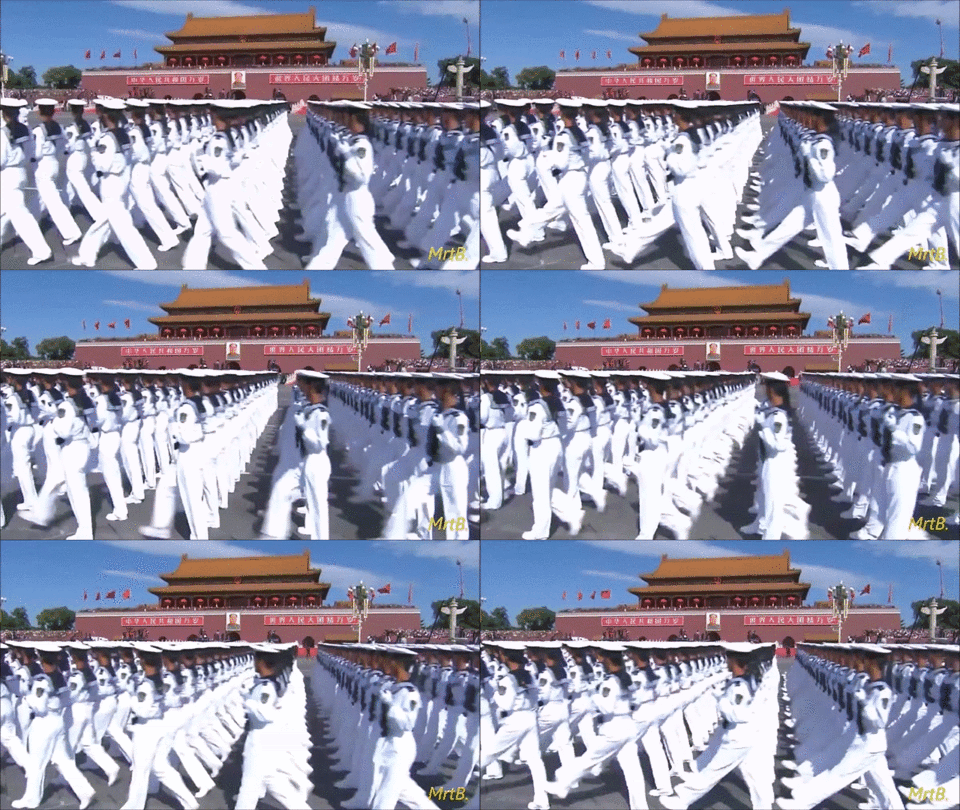
We have this image of the general who commands the army decisively and almost individually, like the conductor of an orchestra.[2] Anthony King already said: “the history of command in war consists essentially of an endless quest for certainty”[3] This image of command gives us a sense of control.
The question is, if it is not like an orchestra, then what? For this, Malcolm Gladwell gives an excellent explanation by making the analogy with improvisation comedy, short-hand improv. In improv there is no script. Someone from the audience can call out a topic, which will then set in motion a play where each actor improvises to what the other actor just did or said. The most important ingredient here is spontaneity. Contrary to what you might think they practise a lot. Why? Because it is governed by a set of rules and when they are on stage, everyone needs to abide by those rules. One of the players: “We think of what we’re doing is a lot like basketball”. You need to make split-second decisions, but before being able to do that in a high-speed game, you first need to train all the basic actions and agree on each other’s role in the game. Gladwell explains that exactly this kind of spontaneity is what made the retired Marine Corps General Paul van Riper’s Red Team beat the rational and planning focussed Blue Forces in the Millennium Challenge (’02).[4]
Gladwell makes a very interesting observation about improv: bad improvisers block action, good improvisers develop action. Check out this part in Gladwell’s book Blink about a piece of improv:
A: I’m having trouble with my leg.
B: I’m afraid I’ll have to amputate.
A: You can’t do that, Doctor.
B: Why not?
A: Because I’m rather attached to it.[5]
This short conversation got stuck. Now see what happens when you abide by the rule that you need to agree with what is being proposed, no matter what.
A: It’s my leg, Doctor.
B: This looks nasty. I shall have to amputate.
A: It’s the one you amputated last time, Doctor.
B: You mean you got pain in your wooden leg?
A: Yes, Doctor.
B: You know what this means?
A: Not woodworm, Doctor!
B: Yes, we’ll have to remove it before it spread to the rest of you.[6]
Besides being more funny, the second conversation instills action and creates possibilities. In improv, there is no script and adaptation is considered to be the main skill. Control is decentralized and authority can shift dynamically depending on who introduces a new idea. It is less precise than an orchestrate but highly flexible and resilient. You can see it as a real-time feedback loop with no fixed destination. Uncertainty is the fuel, not something to be avoided.
What can we learn from this? Thinking like improv creates an atmosphere and command climate of initiative and flexibility. Of course in military command we don’t necessarily need to agree with everything a subordinate thinks is a good idea. Yet the initiative that makes a difference in a tactical fight most often comes from the subordinates that have a better understanding of what’s in front of them. Like the German Lieutenant Colonel Hermann Balck at the battle of Sedan in 1940, clearing bunker after bunker, thereby (partly) securing the left bank of the Meuse. When time is of the essence, you don’t want to block action, you want your people to seize opportunities when they arise. You don’t orchestrate opportunities, you create the conditions for your people to imagine, create and seize them by themselves. This is what mission command and intent is about. Contrary to improv we do need a destination, but this always needs to be much broader than the mission so as to provide freedom to act.[7] We should not confuse our destination with a precise copy of our plans (script).
Whereas the conductor in an orchestra also anticipates what comes next, that what is to be anticipated is already defined, thereby making the range of variation very narrow. As in: “I know what should happen next”. Training is focussed on alignment, timing and avoiding errors. They make predictions within a stable future and lock onto a shared trajectory. They maintain coherence by constraining choice.
Improv on the other hand is more focussed on anticipating other humans. (This is essential for our purposes, for war is still about human beings.) Training is about pattern recognition in uncertain environments, much more like probabilistic predictions. They hold several trajectories lightly, where new information can collapse certain possibilities or open new ones.
An orchestra treats surprise as an error, whereas improv treats surprise as information that can create opportunities.
Conclusion
Words matter. ‘Orchestrating’ operations sets the tone for how you intend to design and lead the operation. Many well experienced commanders likely know the difference. Yet when we truly value concepts like mission command, we should not allow contrary currents to undermine it.
But more importantly, it matters to how we train for real scenarios. Do you believe you can execute your plan accurately without deviations? Or do you train for adaptation? I’d prefer training for adaptation, for this will more likely prepare us for the fight to come. For one thing is certain, since we will not be the aggressor, we will not have the initiative and in the worst case we will be surprised. When you treat surprise as an error, you have already lost the first round.
Thank you for reading! There are only free-subscriptions to Beyond the Art of War. If you do want to make a contribution, you’re welcome to buy me a coffee!
The views expressed are those of the author and do not reflect the official position of the Armed Forces.
[1] “the orchestration of military activities, across all domains and environments, synchronized with non-military activities, to enable the Alliance to deliver converging effects at the speed of relevance”. https://c2coe.org/nato-c2coe-involvement-in-acts-mdo-definition/
[2] Freedman, Lawrence. Command: The Politics of Military Operations from Korea to Ukraine. Oxford: Oxford University Press, 2022.
[3] Van Creveld, Martin. Command in War. Cambridge, MA: Harvard University Press, 1985 (reprint 1987)
[4] Malcolm Gladwell, Blink: the power of thinking without thinking, P114-120
[5] Malcolm Gladwell, Blink: the power of thinking without thinking, P118
[6] Malcolm Gladwell, Blink: the power of thinking without thinking, P119
[7] https://www.usni.org/magazines/proceedings/2025/may/auftragstaktik-leads-decisive-action
Picture: https://www.facebook.com/13lichtebrigade/photos/a.233054330046263/5201770393174607/
Exactly right. I would add that jazz (good jazz at least) works like this as well to extend the musical metaphor.
I've understood that at the highest levels the real art in an orchestral performance is in the interpretation of the music as written on the page along with its annotations. I see BA Friedman noted the role of improvisation in jazz - and I would agree but also note that there are some jazz musicians that demand that perfect recitation every time they perform while others look each time for the opportunity to improvise something new from what's on the page or has already been played. Both kinds of jazz have their place and time - as does "orchestration". I was just watching a YouTube video on the Rhine crossings in 1945. Montgomery was just about to launch his extensively planned and prepared orchestrated crossing complete with artillery barrage profundo etc., only to learn during the night that Patton's Third Army had essentially "bounced" the Rhine with a hastily improvised crossing that successfully established a beachhead on the far shore. Montgomery demanded Patton be sacked for insubordination and ignoring command protocols because his crossing was not authorized and was not in accordance with Allied approved plans. Churchill had to explain to him why he wasn't going to endorse Montgomery's appeal - Patton's hastily improvised and most importantly successful crossing was going to shorten the war. It might overshadow the British Army and Montgomery's meticulously planned crossing and it clearly violated military hierarchy and protocol - but it shortened the war and would mean fewer casualties in the long run. The Invasion of Normandy called for meticulously planned and orchestrated military operations. The pursuit across France and into Germany called for a jazz approach.